Power plugs in Egypt are type C and F at 220 volts, so most Americans only need an adapter


Power plugs in Egypt are type C and F at 220 volts, so most Americans only need an adapter
Egypt uses the continental European outlet: type C and type F, two round pins, at 220 volts and 50 hertz. Your flat-blade American plug will not go into the wall, so you need a Europe plug adapter, the same one you would take to France or Germany. You almost certainly do not need a voltage converter, because phone, laptop, camera and CPAP power supplies are dual voltage and say 100-240V in the small print. The devices that break are single-voltage hair dryers, flat irons and curling irons. Nile cruise cabins run on the ship's generator, hotels have backup power, and a desert camp has no electricity at all. One adapter with USB ports, one power bank, and you are set.
What plug and voltage Egypt actually uses
Egypt runs on the continental European standard. Wall outlets take the type C plug, two round pins about three quarters of an inch apart, and the type F, the same pins in a recessed socket with grounding clips on the sides. A type C plug fits a type F socket, and every adapter sold for Europe covers both. The supply is 220 volts at 50 hertz everywhere in the country.
What you will not find, except in a handful of newer international hotels, is the flat-blade type A or B outlet you have at home. Some bathrooms have a shaver socket that accepts flat blades, but it is low power and will trip under a hair dryer.
In practice the sockets you meet in Egypt are of three kinds:
- The recessed, grounded type F in newer hotels, apartments and cruise cabins. Plugs sit firmly.
- The flat-faced type C in older buildings, cafes and guesthouses, often a little loose, so a heavy adapter can sag or fall out.
- Multi-standard sockets in some international-chain hotels, one block that accepts European, British and American plugs. Never count on it.
220 volts versus the 120 volts you have at home
This is where American travelers get into trouble, because the plug shape is only half the story. US household current is 120 volts at 60 hertz. Egypt delivers 220 volts at 50 hertz, close to double. A device built only for 120 volts and plugged into 220 draws far more current than it was designed for. A cheap hair dryer runs for a few seconds, smells hot and dies, sometimes taking the breaker for the whole floor with it.
The good news is that almost everything else you carry is dual voltage. Phone chargers, laptop bricks, camera battery chargers, tablet and e-reader cables, electric toothbrush bases, wireless headphones and smartwatch pucks all print something like "Input: 100-240V, 50/60Hz" on the label and work anywhere with a plug adapter alone.
The problem devices have a heating element or a motor: hair dryers, curling irons, flat irons, travel kettles, clothes steamers, heating pads and some older shavers. Many cheap ones are 120 volts only. The 50 hertz frequency rarely matters for electronics.
| Device | Usually dual voltage? | What you need in Egypt |
|---|---|---|
| Phone, tablet, laptop charger | Yes | Plug adapter only |
| CPAP machine | Almost every current model | Plug adapter, check the power brick label |
| Electric toothbrush, shaver | Often, but check | Plug adapter, or leave it home |
| Hair dryer, flat iron, curling iron | Often not | Dual-voltage travel model, or use the hotel's |
| Kettle, steamer, heating pad | Rarely | Leave it home |
How to check whether your device is dual voltage
Turn the charger or appliance over and find the small print near the plug or on the power brick. You are looking for the word INPUT followed by a voltage figure.
- "100-240V" or "100-240V~ 50/60Hz". Dual voltage. It works in Egypt with a plug adapter and nothing else.
- "120V" or "110-120V" alone. Single voltage. It will be damaged at 220 volts. It stays home.
- "220-240V". Built for Europe or Asia. It works in Egypt directly, again with the adapter.
- A physical switch marked 120/240 or 115/230. Flip it to the 240 side before you plug in, and check it every morning, because it slides.
CPAP machines
The label that matters is on the power supply brick, not on the machine. Nearly every current CPAP ships with a 100-240 volt supply and needs only the adapter. Bring a short extension cord, because in an older hotel room the free outlet is often far from the bed. Tell us in advance and we ask the hotel for a socket within reach. For a night in the desert, a CPAP needs its own battery pack.
Hair dryers
Every hotel of tourist standard and every cruise cabin we work with has a hair dryer in the room or at reception. Leave yours at home unless you depend on a specific model, in which case buy a dual-voltage travel dryer and set its switch before plugging in.
The adapter to buy, and why a converter is usually the wrong purchase
You need a plug adapter for continental Europe, sold as type C, type F, Schuko or simply "Europe travel adapter". The right one has a grounded type F body with the two side clips, so it seats firmly in a recessed socket, plus two or three USB ports, ideally one USB-C, so a single adapter charges phone, watch and earbuds while the laptop brick uses the socket. Buy two, because one always gets left behind in a cruise cabin.
An adapter changes the shape of the pins so your plug fits the wall. A converter changes the voltage from 220 down to 120. Almost every traveler needs the first and not the second. A converter is heavy, gets hot and is not safe for electronics. If there is a single-voltage device you cannot live without, buy a dual-voltage version of it instead.
| Plug adapter | Voltage converter | |
|---|---|---|
| What it does | Changes the pin shape | Changes 220 V to 120 V |
| Who needs it in Egypt | Every American traveler | Only owners of a single-voltage appliance they refuse to leave |
| Weight and size | Pocket sized | A brick, often heavier than a laptop |
| Safe for electronics | Yes, it is passive | No, most are for heating appliances only |
| Our advice | Bring two | Skip it |
A few buying details that matter more in Egypt than elsewhere:
- Compact over universal. The big all-in-one blocks are heavy and fall out of the loose type C sockets in older buildings.
- If you bring a small US power strip, read its label too. A strip rated only for 120 volts, especially one with surge protection, can fail at 220. Look for a travel strip rated to 240 or 250 volts.
Power on a Nile cruise, cabin by cabin
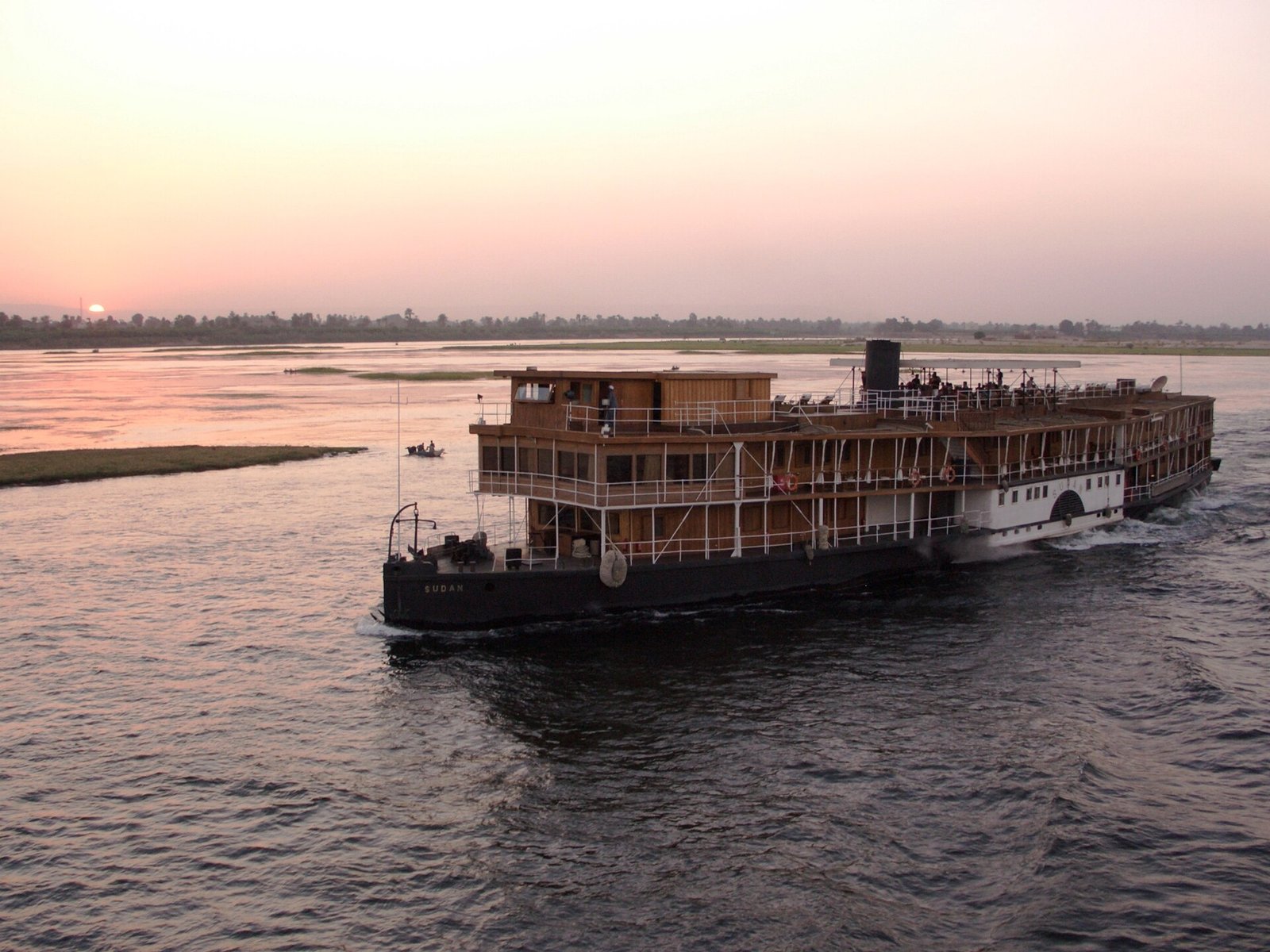
The standard cruise ships between Luxor and Aswan have 220 volt type C or F sockets in every cabin, usually one or two at the desk or vanity, and sometimes a shaver socket in the bathroom. The count is small, so a couple with two phones, a camera, a watch and a tablet runs out of holes on the first night. Newer or refitted boats add USB ports beside the bed. Older boats do not, and the photos never tell you, which is why we keep our own notes on each ship.
Power comes from the ship's own generators, running around the clock, whether sailing or tied up. There is no shore power at most Nile berths. You have electricity all the time, but you will notice a brief flicker when the crew switches generators, typically early morning or on arrival at a mooring. On a few older boats the air conditioning is turned down for a couple of hours at night, and we ask about this when we pick a boat for you.
A sailing dahabiya is a different animal. It has a smaller generator and often a battery bank, and some run the generator only in the evening and early morning, so the cabin sockets are live for a window rather than all day. Arrive with the power bank full and charge during generator hours. The dahabiya Nile cruise guide covers what else changes on a sailing boat.
On board, plug everything in at dinner and again overnight, one device per port, and unplug before the morning excursion. Our packing list for a Nile cruise puts the adapter and the power bank at the top for exactly this reason.
Power cuts, hotels and the desert camp
In the cities and resort towns the supply is stable for most of the year. In the summer heat, when the grid is under strain, short scheduled cuts have hit residential districts in the late afternoon. Hotels of tourist standard have a generator that picks up the load within seconds, so what you notice is a flicker and the air conditioning restarting.
Small hotels, Nubian guesthouses around Aswan and the oasis towns are different. The generator, if there is one, may cover the lights and the water pump but not the air conditioning, and a cut can last longer. Keep a flashlight in the day bag, and unplug the laptop during a cut, since the moment the power returns is when a spike is most likely.
A desert camp has no grid at all. In the White Desert the Bedouin camp is a windbreak, a fire, lanterns and stars, and the same is true around Siwa and Bahariya. Everything you want the next morning has to be charged before you leave the last hotel. Cold desert nights drain lithium batteries fast, so keep the phone and camera battery inside the sleeping bag. The 4x4 has a 12 volt socket, fine for a phone on the drive back, not for a camera battery. The White Desert guide explains what a night out there looks like.
On surge protection: the real risk for a laptop or camera is the spike when a generator kicks in or drops out. A small surge-protected travel strip rated for 240 volts is the only extra hardware worth its weight.
Power banks, domestic flights and charging etiquette
Bring a power bank. A phone that lasted all day at home is on its last bar by the Valley of the Kings. A bank in the 10,000 to 20,000 mAh range is the sweet spot: enough for a full day, light enough to forget. Charge it every night with everything else.
On flights, a power bank and any spare lithium battery travel in your carry-on, never in checked luggage, and airlines cap the very large ones. A normal travel-sized bank with its capacity printed on the case will not be questioned. This applies to the short hops between Cairo, Luxor, Aswan and Hurghada too; our guide to domestic flights in Egypt covers the rest of the cabin rules.
Charging away from the hotel is easy if you ask first:
- In the car. Every vehicle we use has USB ports or a lighter socket. Plug in for the long stretches between sites.
- In cafes and restaurants. Usually yes, and the socket is often behind the counter, so the staff will charge it for you. Order something and do not walk off without it.
- In temples, tombs and museums. No. The sockets you see are for the lighting and cleaning crews.
Two habits stretch a battery further than any accessory. Switch to low power mode in the morning rather than when it is already low, and download offline maps before the day starts so the phone stops hunting for a signal inside a tomb. For a local data plan, the SIM card and mobile internet guide explains the options, and the camera rules guide covers spare camera batteries.
What to bring, and what to leave at home
Here is the electrical part of the packing list, the part that fits in one zip bag.
- Two Europe plug adapters, type C or F, grounded, with USB ports.
- One compact multi-port USB charger rated 100-240 volts.
- Cables for every device, plus one spare USB-C cable.
- A power bank in the 10,000 to 20,000 mAh range, in the carry-on.
- Spare camera batteries.
- A small travel power strip rated to 240 volts, only if you travel with more than four devices.
- A dual-voltage travel hair dryer, only if you cannot use the hotel's.
- For CPAP users, the power brick, a short extension cord, a spare filter and a battery pack for the desert night.
- A small flashlight or headlamp.
And the things to take out of the suitcase before you close it:
- A single-voltage hair dryer, curling iron or flat iron. It will die on the first use.
- A travel kettle. Every hotel room has a kettle or room service.
- A clothes steamer or iron. Hotels and cruise ships have laundry and pressing.
- A voltage converter. Heavy, hot and unnecessary.
The rest of the suitcase is in our what to pack for Egypt guide, and the full pre-departure run-through, from passport validity to the adapter, is the Egypt travel checklist.
How Explora Egipto handles the electrical details for you
This is the kind of detail that gets lost between the big questions of which temples and how many nights. When we recommend a cruise boat, we note whether the cabins have USB by the bed and how many sockets there are. When we book a hotel, we say whether it has a multi-standard outlet and, if you use a CPAP, we ask for a room with a socket within reach of the bed.
Our vehicles have USB ports. The evening before a desert night, your guide reminds you to charge everything. If you land without an adapter, the guide knows the shop near your hotel that sells the right one.
Tell us your dates, who is traveling and which devices you cannot do without, and we come back with an itinerary that has already thought about where you will charge your phone, and the quote.
Frequently asked questions
What type of plug adapter do I need for Egypt?
A continental Europe adapter, type C or type F, the same one you would take to France, Germany or Italy. Egyptian sockets have two round holes and, in newer buildings, a recessed face with grounding clips. Choose a grounded type F adapter with two or three USB ports and bring two.
Do I need a voltage converter for Egypt?
Almost certainly not. Egypt is 220 volts at 50 hertz, and phone, laptop, tablet, camera and CPAP power supplies are dual voltage, marked 100-240V on the label, so they need only a plug adapter. A converter is only for a single-voltage appliance with a heating element, like a cheap hair dryer.
Will my American hair dryer work in Egypt?
Only if it is dual voltage and switched to the 240 setting. A standard 120 volt dryer plugged into an Egyptian outlet will burn out within seconds and may trip the breaker. Every hotel of tourist standard and every cruise cabin has a hair dryer in the room or at reception, so the easiest answer is to leave yours at home and use theirs.
Can I use my CPAP machine in Egypt?
Yes. Check the power brick, which on nearly every current model reads 100-240V, and bring a plug adapter and a short extension cord, since the outlet in older rooms can be far from the bed. Tell us in advance and we request a suitable room. For a night in a desert camp there is no electricity, so you need the manufacturer's battery pack for that night.
Are there power outlets in Nile cruise cabins?
Yes, one or two type C or F sockets per cabin at 220 volts, and on newer boats USB ports beside the bed. Power comes from the ship's generators around the clock, with a brief flicker when they switch over. Sockets are few, so bring a multi-port adapter. A sailing dahabiya may run its generator only in the evening and morning, so charge during those hours.
Are power outages common in Egypt?
In cities and hotels they are short and rare, and tourist hotels and cruise ships have backup generators that start within seconds. Summer heat can bring brief scheduled cuts in residential areas. Small guesthouses and oasis towns feel them longer, and a desert camp has no electricity at all. Charge when you can rather than when you must.
Pack one adapter, charge one power bank, and let us handle the rest
Tell us your dates, who is traveling and what you need to keep charged, from a camera to a CPAP, and we come back with an itinerary that already knows which boat has USB by the bed and which night has no electricity at all. Write to us and we send you the quote.